
Perth Amboy Elite Roofing provides commercial roofing in Perth Amboy, NJ, serving surrounding cities including South Amboy, Metuchen, South River, Highland Park and Roselle Park. Our 20+ years of roofing include the flat and low-slope roofs on storefronts, mixed-use buildings with apartments above, small apartment buildings and light commercial properties.
Commercial roofs here are rarely large warehouses. They are more often a few thousand square feet of membrane behind a parapet, with a sign, a rooftop unit and tenants upstairs. That combination calls for a roofer who understands membranes, masonry flashing and the logistics of working over an open business, and the sections below explain how we handle each.
Flat Roof Membranes for Commercial Buildings
Modified Bitumen
Torch-down SBS and APP modified bitumen is common on the city’s commercial and mixed-use buildings. It goes down in overlapping layers, tolerates foot traffic from service technicians, and can be repaired by bonding new cap sheet over a damaged area. Its seams depend on good workmanship at installation, which is why we check every lap on an existing roof.
EPDM Rubber
EPDM rubber membrane comes in large sheets, so a roof can be covered with few seams. It handles temperature swings well and is straightforward to patch. Its weak points are the adhesive at seams and the flashing around penetrations, which dry out with age and need attention before the field of the membrane does.
TPO and PVC Single-Ply
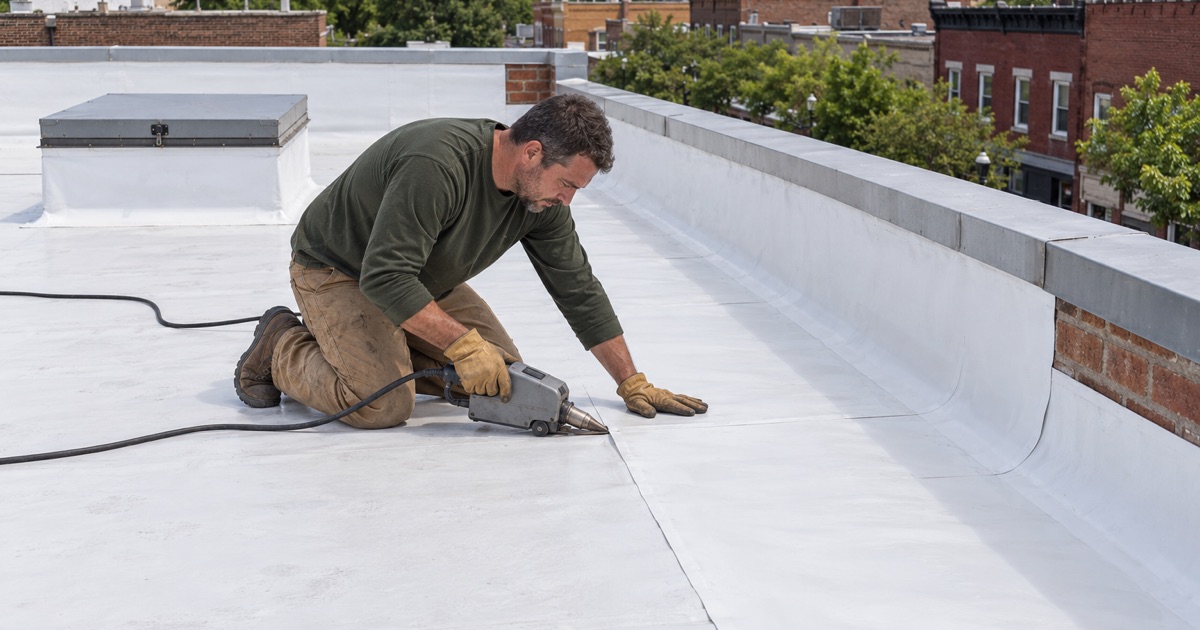
TPO and PVC membranes are joined with hot-air welds that fuse the sheets into a continuous surface, making their seams strong against ponding water. Both are typically white or light gray, reflecting summer heat away from the building. PVC holds up better where grease or chemicals reach the roof, such as above a restaurant kitchen exhaust.
Built-Up Roofing and Coatings
Some older buildings still carry built-up roofing, layers of felt and asphalt topped with gravel. We assess whether it can be repaired in kind or should be replaced with a modern membrane. Roof coatings can extend the life of a sound membrane, but only after the roof underneath has been checked for wet insulation and open seams.
Parapets, Drains and Rooftop Details
Parapet Walls and Coping
Most storefront buildings have parapet walls along the street and sides. The coping on top of the wall, the through-wall flashing inside it and the counter flashing at its base all keep water out of the masonry. Cracked coping joints and failed base flashing are among the most common sources of leaks we find on these buildings, often showing up inside far from the actual cause.
Drains, Scuppers and Conductor Heads
A flat roof depends on its drainage. Interior roof drains need strainers to keep debris out of the pipe, scuppers through the parapet need to be open and flashed, and conductor heads have to be sized to carry the water into the leaders. We clear, repair and reflash these outlets as part of every commercial job, because blocked drainage turns small defects into large leaks.
Rooftop Units, Curbs and Signs
HVAC units, exhaust fans and sign supports sit on curbs or stands that pierce the roof. Each needs flashing tied into the membrane, and each gets walked on by service technicians who may not think about the roof. We reflash curbs, add walkway pads where traffic is heavy, and make sure equipment stands are not wearing through the membrane.
Restaurant Exhaust and Grease on the Roof
A restaurant or takeout shop on the ground floor usually vents its kitchen exhaust through the roof, and grease from that fan settles on the membrane around it. Asphalt-based roofs and EPDM soften and break down under grease, while PVC resists it far better. Around kitchen exhaust we recommend a grease-resistant membrane or a containment system under the fan, and we check the flashing at the fan curb, where grease and heat age the seal fastest.
Mixed-Use Buildings With Apartments Above
Working Over a Business and Tenants
A storefront with apartments above has people underneath the roof all day. We schedule the work so the store can stay open where possible, keep the sidewalk and entrance clear, and notify tenants in advance of when the crew will be there and where access is needed. At the end of each day the site is cleaned, including a magnet sweep for nails.
Permits and Inspections
New Jersey’s ordinary-maintenance exemption applies only to detached one- and two-family houses, so commercial, mixed-use and multifamily roofs need a permit. In Perth Amboy that work goes through the Department of Code Enforcement on New Brunswick Avenue. We confirm the requirements and plan for the inspections before work begins.
Commercial Roof Repair, Recover or Replacement
When a Repair Is Enough
Many commercial leaks are confined to a seam, a drain, a curb or a parapet. When the rest of the membrane is sound and the insulation is dry, a repair at the source is the right answer, and we give you that answer before discussing replacement.
Recovering Versus Tearing Off
If the roof has a single existing layer and dry insulation, a recover membrane installed over it can be an option. If there are already two layers, or the insulation is wet, everything comes off to the deck, as the state re-roofing rule requires. Tearing off also lets us correct ponding with tapered insulation and add drains where water collects.
Written Scopes and Contracts
Our commercial scopes list tear-off, insulation, membrane, flashing, drains and edge metal as separate lines, so you can compare bids item by item. Any damaged deck found during the work is photographed and shown to you before it is replaced.
- 20+ Years in Roofing
- Itemized Written Estimates
- Attic-to-Roof Leak Tracing