
Perth Amboy Elite Roofing handles emergency roof repair in Perth Amboy, NJ, serving surrounding cities including South Amboy, Metuchen, South River, Highland Park and Roselle Park. Over 20+ years we have answered calls after nor’easters, summer thunderstorms and falling limbs, and the job is always the same at the start: stop the water, then fix the roof properly.
An emergency repair has two parts. The first is temporary, a tarp or seal that keeps more water out tonight. The second is the permanent repair, done once the roof is dry and the materials are on hand. We are clear about which is which, and the temporary part is never left in place as the answer.
What to Do Before We Arrive
Protect the Inside of the House
Move furniture, electronics and rugs away from the leak and put a bucket or bin under the drip. If a ceiling is bulging with trapped water, a small hole in the lowest point lets it drain in one place rather than bringing down a larger section. If water is reaching light fixtures or outlets, turn off that circuit at the panel.
Stay Safe and Off the Roof
Wet roofs are slick, storm-damaged decking may not hold weight, and fallen wires can be draped across gutters or branches. Do not climb onto the roof to check the damage. Photographs from the yard, the street and the attic are safer and just as useful for the record.
Start the Record for Your Claim
Photograph the damage inside and outside before anything is moved or covered, note the date and time of the storm, and keep receipts for anything you buy or pay for to prevent further damage. Those records are what your insurer will ask for first.
Emergency Tarping and Temporary Sealing
Securing a Tarp That Stays Put
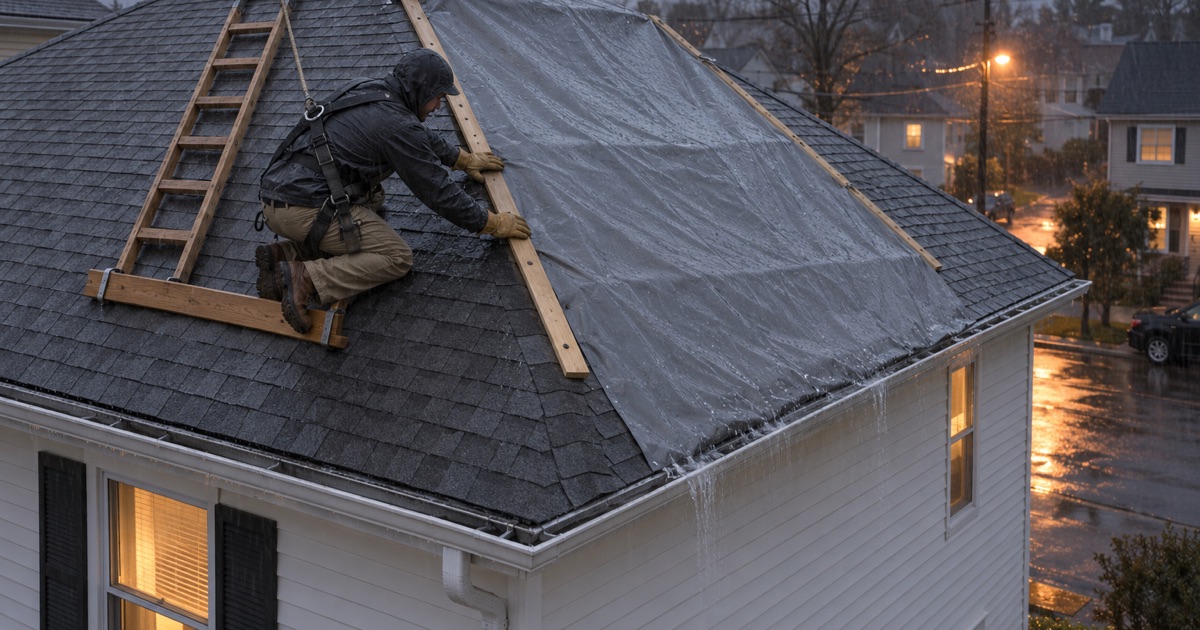
A tarp that flaps loose in the next gust does more harm than good. We extend tarps over the ridge where possible, fasten them along battens so the wind cannot get underneath, and cover enough of the surrounding roof that water running down the slope is carried over the damaged area rather than under it.
On a flat or low-slope roof, a tarp is not always the right tool. Temporary membrane patches or sealing tape over a split seam can be more effective until the roof can be rebuilt.
Temporary Seals Around Flashing and Penetrations
When wind peels back step flashing, lifts a vent hood or loosens a skylight curb, the fastest way to stop the leak is often to reset and seal that piece temporarily. We note on the paperwork what was done as a stopgap, so the permanent repair replaces it rather than leaving the seal to fail a few months later.
Openings From Trees and Limbs
A limb through the roof leaves broken decking and sometimes damaged rafters. Once the tree company has cleared the debris, we cover the opening with plywood or a tarp over a temporary frame so the roof sheds water. If rafters are cracked, the permanent repair becomes structural, which in New Jersey goes through the construction office even on a house.
Flat Roof and Rental Emergencies
On a two-family house or a small apartment building, a flat rear roof that fails in a storm can put water into an occupied apartment. A clogged scupper or roof drain is a frequent cause, since water rises over seams that were only built to shed it. Clearing the outlet often stops the leak within minutes, and the seams that sat underwater are checked and repaired afterward.
When tenants are affected, we let them know when the crew will arrive and where we need access, so the owner is not left coordinating every visit during an already stressful day.
The Permanent Repair
Tracing Everything the Storm Damaged
Once the roof is dry, we inspect the whole roof, not only the obvious hole. Storm damage often includes creased shingles that have not yet blown off, loosened ridge caps, bent drip edge and gutters pulled from the fascia. We also check the attic for wet decking and insulation, since water often spreads further than the stain suggests.
Matching Materials and Replacing Flashing
The repair uses shingles matched as closely as possible to the existing roof, new underlayment where the old has been torn, and new flashing wherever the storm bent or loosened it. Reusing damaged flashing is how a repaired roof leaks again in the next storm.
When the Emergency Reveals a Worn-Out Roof
Sometimes a storm exposes a roof that was already near the end of its life, with brittle shingles cracking around every repair. In that case we tell you plainly that a repair will be short-lived, explain why, and let you decide, rather than patching a roof that will keep failing.
Storm Damage and Insurance
Documentation for Your Own Claim
We photograph the damage on the roof and write up what we found, separating fresh storm damage from older wear. That record is for you to submit with your claim, and it gives the adjuster a clear picture of what happened.
Meeting the Adjuster
When you ask, our crew will meet the insurance adjuster on site to show the damage from the roof. We do not negotiate or settle claims, because in New Jersey that is the role of a licensed public adjuster under N.J.S.A. 17:22B. The claim and its decisions stay yours.
Flood Zones and Large Storm Repairs
For buildings in FEMA flood zones near the bay, a large storm repair can trigger the substantial damage rules if total repair costs approach half the building’s value. If your house is in a mapped zone, check with the city’s floodplain office before major repairs begin.
- 20+ Years in Roofing
- Itemized Written Estimates
- Attic-to-Roof Leak Tracing