Perth Amboy Elite Roofing handles roofing in Florham Park with more than 20 years in the trade, and on a re-roof here one decision deserves more attention than it usually gets: how much ice-and-water membrane belongs at the eaves. We answer it with the local snow record and the state code laid out side by side, not with a rule of thumb. That conversation happens before any price is written down.
Most of what a new roof costs is visible in the materials list, but the underlayment at the edge of the roof is easy to skim past. Our written scopes break out tear-off, decking, underlayment, flashing, ventilation and gutters as separate lines, so you can see exactly how many feet of membrane each bid includes. Two estimates that look alike on the total can differ right there.
If your roof is leaking now rather than due for replacement, we start somewhere else. We look in the attic or at the top-floor ceiling as well as on the roof, trace the water to where it actually enters, and tell you plainly whether a repair will hold before replacement comes up at all.
Snow on Florham Park Roofs, by the Station Record
Where the Numbers Come From
The nearest long-term weather station with published snow normals is Canoe Brook, about three miles southeast of the borough, so its figures describe the surrounding area, not a gauge inside it. NOAA’s 1991-2020 normals for that station put annual snowfall at 24.0 inches, with 18.3 of it arriving from December through February. We use those numbers because they are the closest measured record available.
Snowfall totals alone undersell what a roof experiences, because what matters at the eaves is how long snow stays put. The same station averages 24.3 days a year with an inch or more on the ground and 11.3 days with 5 inches or more. That is the better part of a month of snow cover in the area each winter, not a dusting that melts by noon.
What January and February Look Like
January at Canoe Brook averages a low of 21.9 degrees and a high of 39.5, and February runs 23.0 and 41.8. Those are the months that carry most of the season’s snow, 5.8 inches in January and 8.4 in February. Days that climb above freezing and nights that drop well below it are the normal pattern, not the exception.
That swing is what makes snow at the roof edge matter. Heat escaping through the attic can soften snow higher on the slope during the day, and the water runs down to an eave that sits over the cold overhang and stays frozen. Ice that forms there can back water up under shingles, which is the problem an eave membrane is meant to answer.
What the Record Does Not Tell You
We have no count of ice dams, snow loads or storm damage specific to Florham Park, and we will not invent one. The station record shows how much snow the area sees and how long it lingers. How your particular roof handles that depends on its pitch, its attic ventilation and insulation, and how much shade the north side gets.
That is why we look at the attic before recommending anything at the eaves. Frost on the underside of the deck, stained sheathing near the wall line, or blocked soffit vents tell us more about your house than a regional average can. Ventilation problems found there go on the scope as their own line rather than being folded into the membrane price.
Looking for roofing closer to Eatontown? See Roofing Services in Eatontown.
Where New Jersey Requires an Ice Barrier, and Where It Does Not
The State Amendment and Its 25-Degree Trigger
New Jersey amends the International Residential Code through N.J.A.C. 5:23-3.21(c), and its version of section R905.1.2 ties the ice barrier to areas where the average daily temperature in January is 25 degrees or less. The state’s Table R301.2 then points to DCA Bulletin 07-3 to say where that area is. The bulletin’s answer is short: for New Jersey, it is Sussex County.
That amendment carries forward into the 2024 code adoption that took effect August 17, 2026, so the rule has not changed with the new edition. Florham Park sits in Morris County, not Sussex. On a house here, an eave ice barrier is not something the state code makes you install, and if a bid describes it as mandatory, ask which section the contractor means.
Why Florham Park Falls Outside It
The nearby station record is consistent with that line. Averaging Canoe Brook’s January low of 21.9 and high of 39.5 gives roughly 30.7 degrees, our own arithmetic rather than a published figure, and comfortably above the 25-degree line. Sussex County, farther northwest, is where the state places the colder January the amendment was written for. Clearing the code trigger, though, is not the same as clearing the snow.
The temperature test and the snow record answer different questions. One decides whether the code sets a minimum; the other describes what a roof around here actually sits under for a few weeks each winter. Because the code is silent here, the eave decision falls to you as the owner, and we would rather you make it with both sets of numbers in hand.
Who to Ask About the Code
Questions about which code edition applies to your house, or whether your project needs any paperwork, go to the borough’s Building / Code Enforcement department at 111 Ridgedale Avenue, Second Floor. The office is open Monday through Friday, 9 AM to 4 PM, and the Construction Official also serves as the Building Sub-code Official. We are glad to have that conversation alongside you.
Deciding on Eave Membrane, and How Far Up It Runs
When the Decision Gets Made
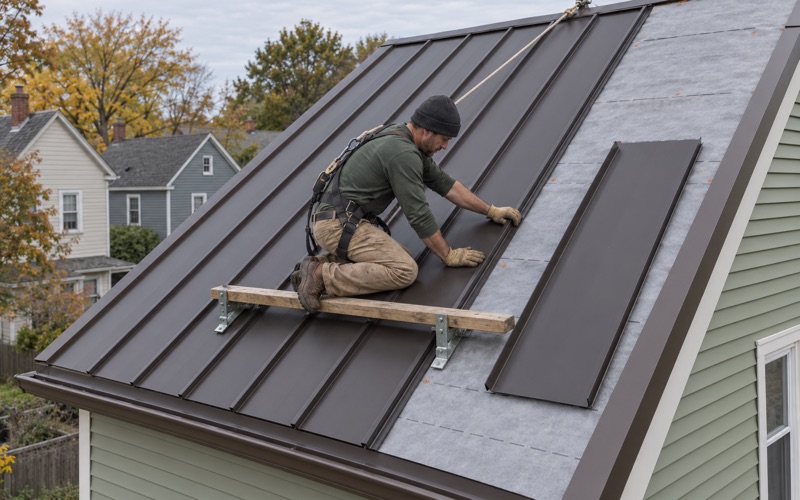
Whether a re-roof here goes over the old shingles or starts with a full tear-off also matters at the eaves. New Jersey’s rehabilitation subcode, N.J.A.C. 5:23-6, calls for removing the existing covering when two or more layers are already on the roof, or when it is slate, wood shake or tile. A self-adhering membrane needs a bare, clean deck to bond to, so the eave question is really a tear-off question.
We raise the membrane question while the scope is being written, not after the crew has the old roof off. Once you have seen the station numbers and what we found in the attic, you choose between membrane at the eaves, membrane at the eaves and in the valleys, or synthetic underlayment meeting ASTM D8257 across the field with no self-adhering edge at all.
What the Membrane Is and How It Is Priced
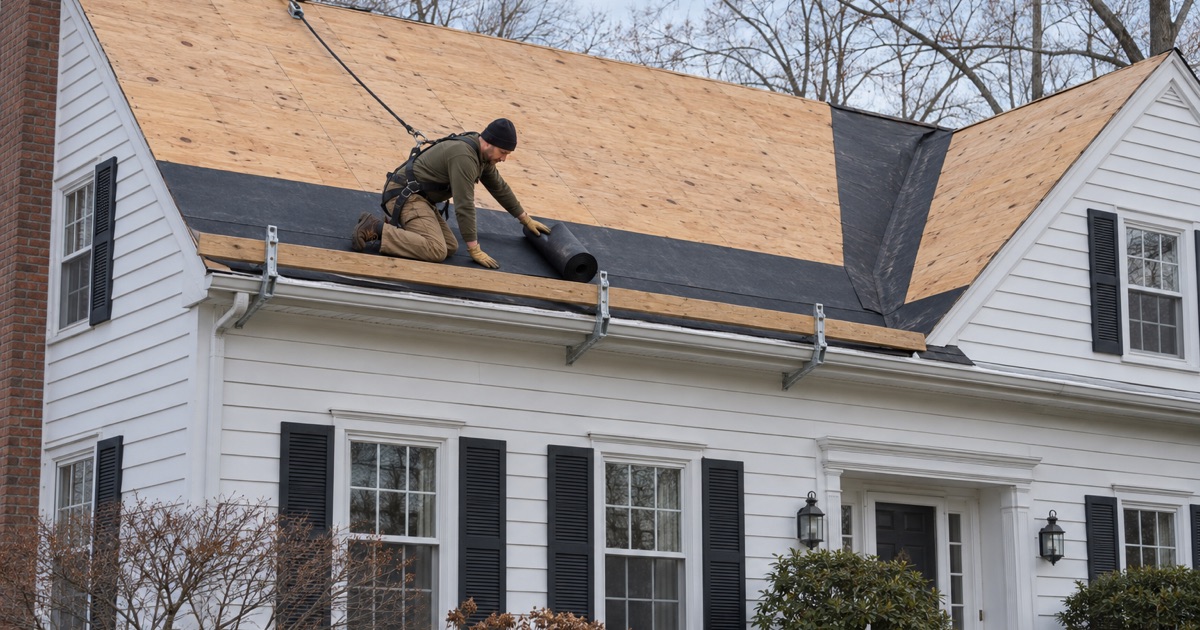
Ice-and-water membrane is a self-adhering sheet, made to ASTM D1970, that bonds to the deck and seals around each nail driven through it. Ordinary underlayment sheds water running downhill; the membrane is there for water pushed uphill by an ice ridge at the gutter line. It costs more per square than synthetic underlayment, which is why it should be priced as its own line.
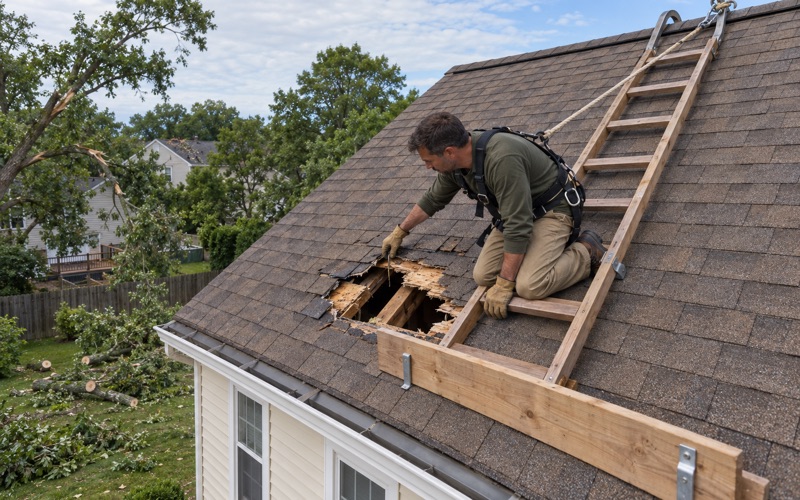
On our estimates you will see the membrane listed by where it goes and how far, separate from the field underlayment, the drip edge and the gutters. We present it as your choice, explain the tradeoff plainly, and do not dress it up as a requirement. If the old deck turns out to be soft at the eaves, we photograph it and show you before replacing any sheets, at the per-sheet price written into the contract.
How Far Up the Roof It Should Run
The common reference point comes from the model code’s own wording: membrane from the lowest edge of the roof to a point inside the exterior wall line. That way it covers the cold overhang plus the first stretch of deck above heated rooms, which is where meltwater tends to stall and refreeze. The width of the roll matters less than where that wall line falls on your house.
A deep overhang or a low-pitched roof can push that line two courses of membrane up the slope, while a steep roof with a tight eave may need only one. We measure the overhang and the pitch on your house and write the coverage into the scope in feet, so you know exactly where the membrane stops before the first sheet goes down.
Valleys, Low-Slope Sections and Other Places Snow Sits
Valleys, Dormers and Chimneys
Valleys collect snow sliding off two planes at once, and they are often the last part of a roof to clear. On a Florham Park re-roof where you choose membrane at the eaves, we generally recommend running it the full length of every valley as well, since that is where meltwater concentrates and moves slowest.
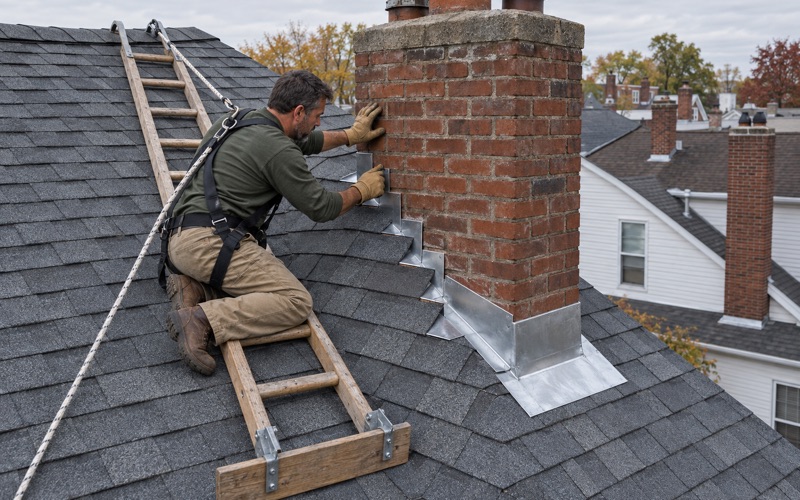
Dormer cheeks, sidewall corners and the uphill side of a chimney catch drifting snow the same way. Step flashing, counter flashing and chimney flashing are replaced with the new roof rather than reused under it, and a chimney wide enough to dam snow gets a cricket built behind it so water is turned aside instead of pooling.
Porch Roofs and Low-Slope Additions
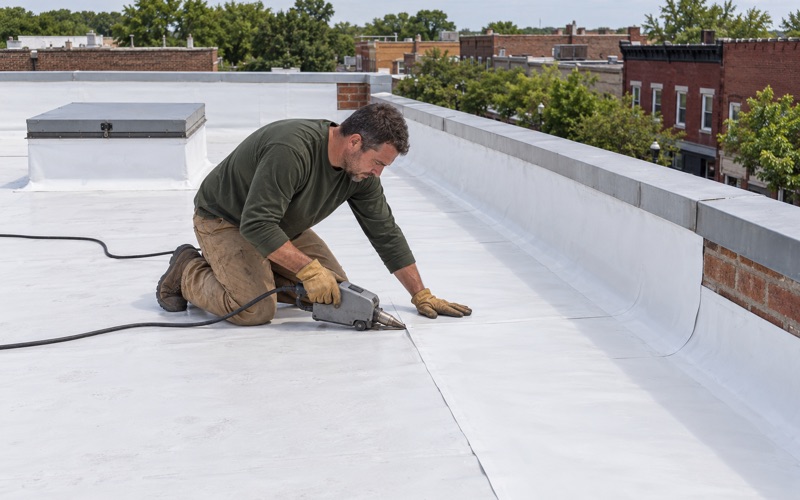
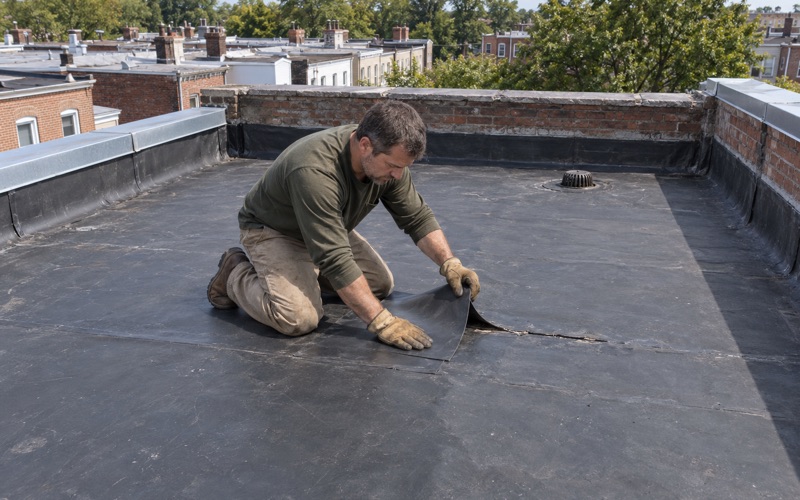
Shallow sections, such as a porch roof, a rear addition or the lower pitch where a roof flattens near the gutter, hold snow longer than the main slopes around them. Shingles are not made for very low pitches, and on those areas we look at whether membrane under the shingles is enough or whether the section should be a membrane roof like EPDM or modified bitumen.
When a flat or near-flat section is already there, we check it at the seams, the edge metal and the drain or scupper, not only where an old patch shows. Snow that melts on a low-slope roof has nowhere to go if the outlet is blocked, so the drainage path matters as much as the surface.
Gutters, Drip Edge and the Work Day
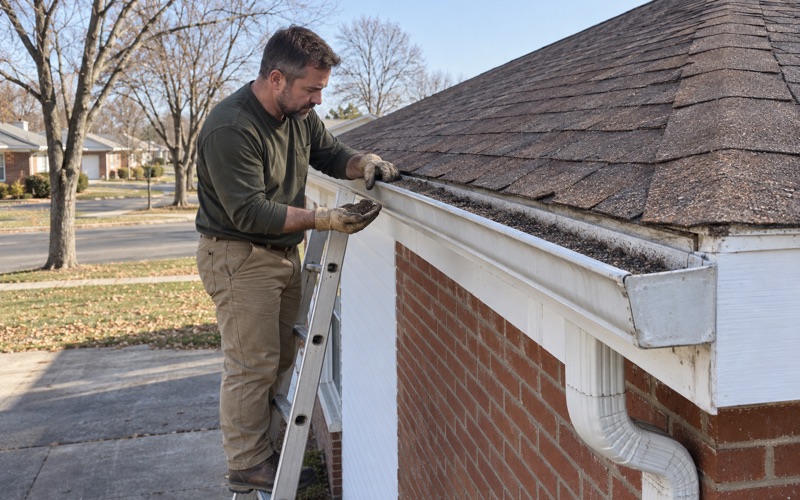
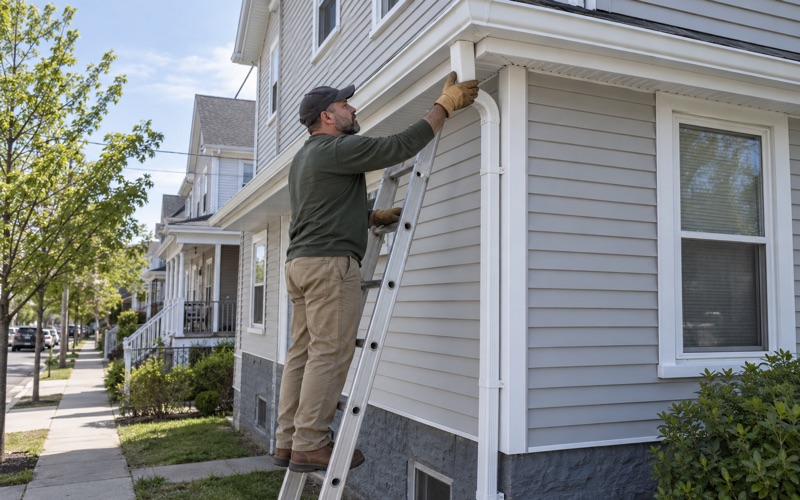
The eave membrane works with the drip edge, not against it. We lap the membrane and drip edge in the order that keeps water on top of each layer, and we check that the gutters and leaders pitch toward their outlets, because a gutter holding water through a freeze can build ice right where the roof edge is most exposed.
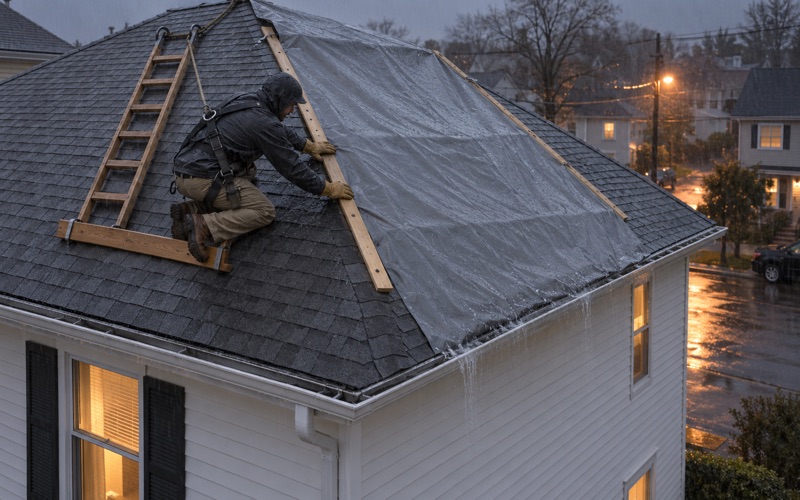
Winter storm and wind advisories for the borough come out under National Weather Service forecast zone NJZ008, Morris, from the Mount Holly office, and we watch them when scheduling a tear-off. At the end of each work day the sidewalk, yard and gutters are cleaned, including a magnet sweep for nails, so nothing is left buried under the next snowfall.
- 20+ Years in Roofing
- Itemized Written Estimates
- Attic-to-Roof Leak Tracing