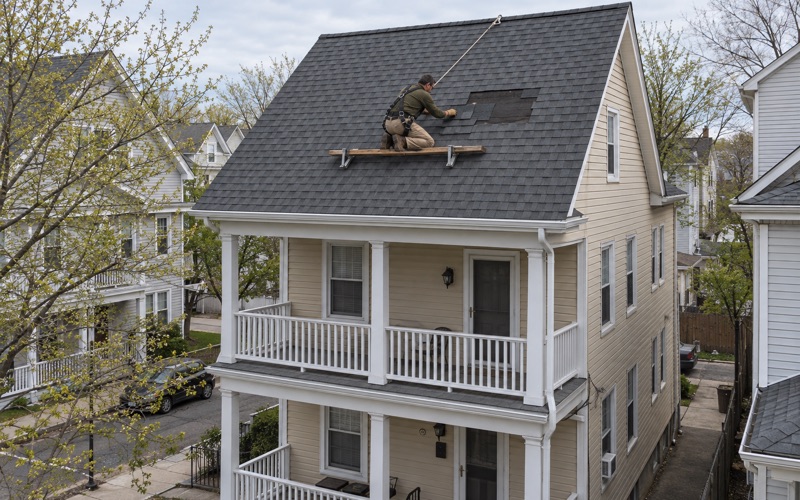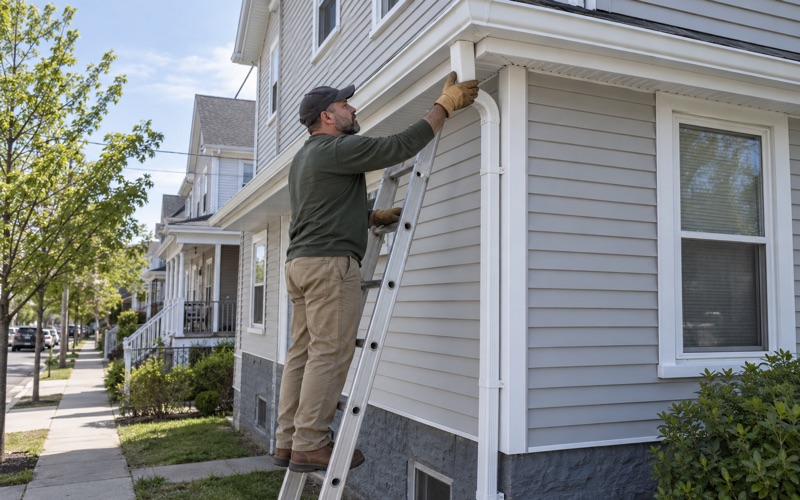
Perth Amboy Elite Roofing offers roofing in Lincoln Park backed by more than 20 years in the trade, and the first thing we settle on any job is how the materials will reach the roof. On most houses that means ladders, a hoist and a crew carrying bundles up by hand. On a few jobs it means a crane or boom lift, and in this borough that choice carries a question most towns never ask.
Before anything is priced, we give a straight answer on whether the roof can be repaired. A leak call here gets a look in the attic or top-floor ceiling as well as on the shingles, so we find where the water actually gets in. Only when repair genuinely will not hold do we talk about replacement, and then the scope is written line by line.
When replacement is the answer, the written scope separates tear-off, decking, underlayment, flashing, ventilation and gutters, so you can lay our estimate beside another and compare each item. It also states how materials will be delivered. That line matters more in Lincoln Park than in most places, for reasons the rest of this page explains.
An Airfield Inside the Borough
Lincoln Park has its own airport, and it shapes how we plan the occasional heavy lift in this Morris County borough. Nothing about a typical shingle job touches airspace. The question only arises when equipment rises well above the roofline, so it helps to know what the field is and which rule applies to it.
Lincoln Park Airport, N07
Lincoln Park Airport carries the FAA identifier N07 and sits about two nautical miles north of the borough’s central business district. It is privately owned and open to public use. The field has a single asphalt runway, designated 1/19, measuring 2,942 by 40 feet, at an elevation of 182 feet. For a roofer, that location is a reason to look at a map before booking tall equipment.
For roofing purposes, the runway length is the number that matters. Federal airspace rules sort airports by their longest runway, and the 2,942-foot strip at N07 falls into the shorter class. That class decides which notice surface applies to anything built or raised near the field. Most homeowners never hear about it, because most jobs never come close.
Short Runway, 50-to-1 Surface
The rule is 14 CFR 77.9. For an airport whose longest runway is no more than 3,200 feet in actual length, paragraph (b)(2) requires notice for construction or alteration that would exceed an imaginary surface rising at 50 to 1 for a horizontal distance of 10,000 feet from the nearest point of the nearest runway. That paragraph is the one that governs around N07.
In plain terms, a 50-to-1 surface climbs one foot for every 50 feet you move away from the runway. Close to the field, the height that triggers notice is modest; farther out, it grows, until the surface stops applying at the 10,000-foot mark. A boom height that would raise no question across most of the state can raise one here.
The Shielding Exception
Paragraph (e)(1) of the same section exempts objects shielded by existing structures of a permanent and substantial nature, or by natural terrain, in congested areas where safety is not affected. A crane boom beside taller buildings may fall under it. Whether it does depends on the exact site, and it is not a judgment we make by eye.
We have not run an obstruction calculation for any particular street in Lincoln Park, and a rule of thumb is no substitute for one. What the regulation does tell us is when to ask. That question gets raised during planning, not once a crane is already parked at the curb. It costs nothing to ask early and a good deal to ask late.
Looking for roofing closer to Maywood? See Roofing Services in Maywood.
When a Roofing Crane Needs an FAA Notice Check
Most roofing work in Lincoln Park never calls for a crane. When one does, usually for heavy material on a large or hard-to-reach roof, the airport becomes part of the scheduling conversation. Here is how we handle that conversation from estimate to delivery day.
Checking the Surface Before the Truck Arrives
If a lift is planned near the north end of town, we check it against the 50-to-1 surface before the equipment is booked. That means comparing where the job sits relative to the runway with how high the boom will reach. The work happens on paper first, so a delivery date is never built around a lift that may need review.
Filing an FAA notice is not part of our scope, and we say so in writing. Where the check suggests notice may be needed, we raise it with the owner and the crane provider early, so whoever sponsors the lift can handle it. We promise no review timeline, because that is outside our hands.
Equipment That Stays Low
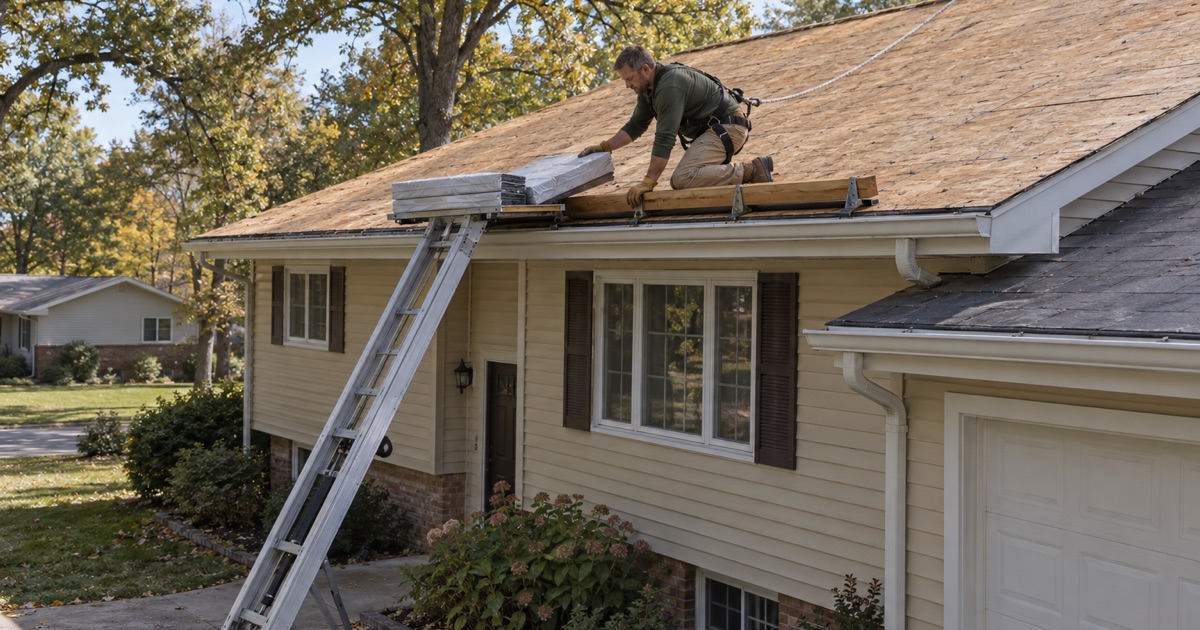
Often the simpler answer is a different machine. A ladder hoist delivers shingles to the eave without putting anything tall into the sky, and on a typical house the crew can work around that pace. We weigh the extra labor of hand-loading against the scheduling questions a tall boom may bring near the airfield.
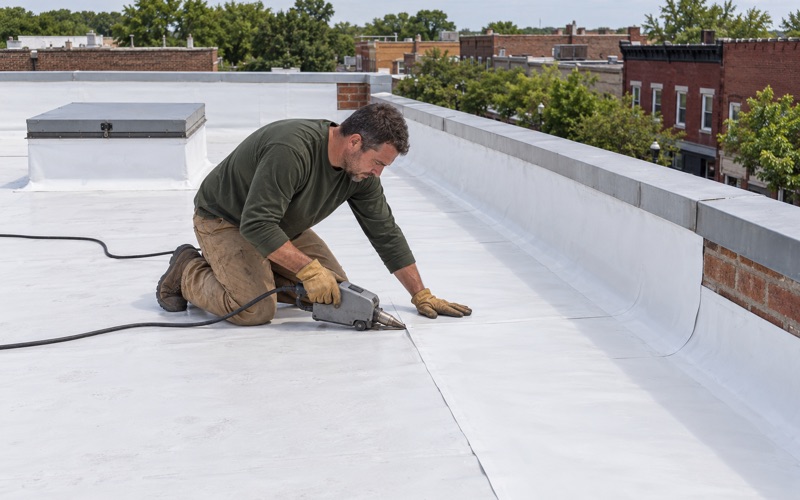
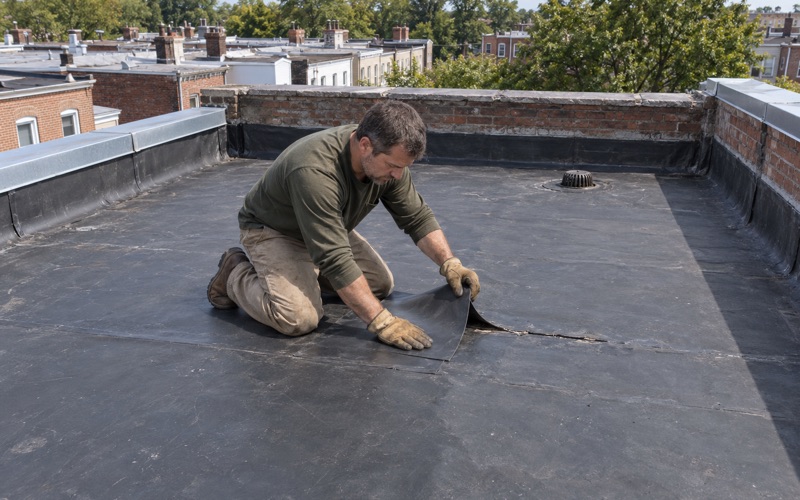
Low-slope rear roofs get the same thinking. Rolls of membrane and modified bitumen are heavy but manageable with a hoist, and our inspection still covers the seams, the edge metal and the drain or scupper rather than only the visible patch. A flat rear roof over a porch or addition usually needs nothing taller than a ladder. The delivery method changes; the inspection standard does not.
Solar Arrays and Heavy Materials
Roofs carrying solar panels are planned with the removal and reinstall built into the schedule. That coordination already involves a second trade, so we settle early how panels come down and go back up. If anyone proposes a lift to move equipment, the same airspace check applies before the date is fixed.
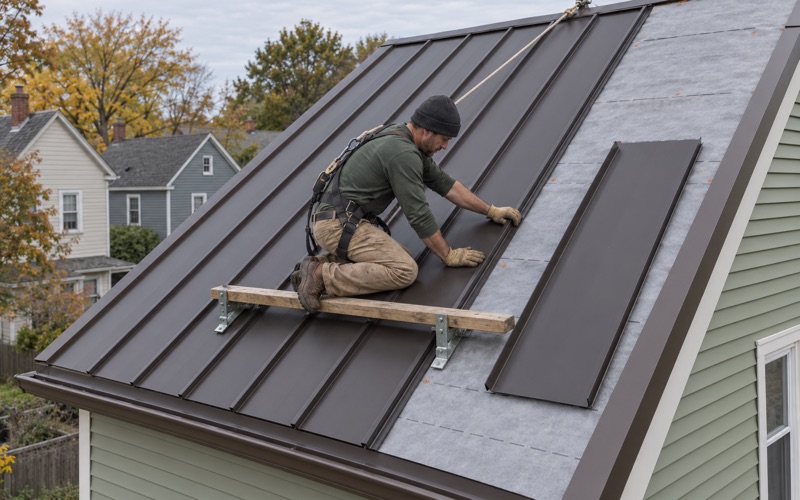
Slate and standing seam metal sometimes tempt crews toward a crane because of weight or panel length. We look first at whether the material can be staged and carried instead. When it truly cannot, the lift is treated as a planned event with its own check, not a last-minute rental. That decision is written into the scope so you see it before signing.
Most Re-Roofs Never Leave the Ladder
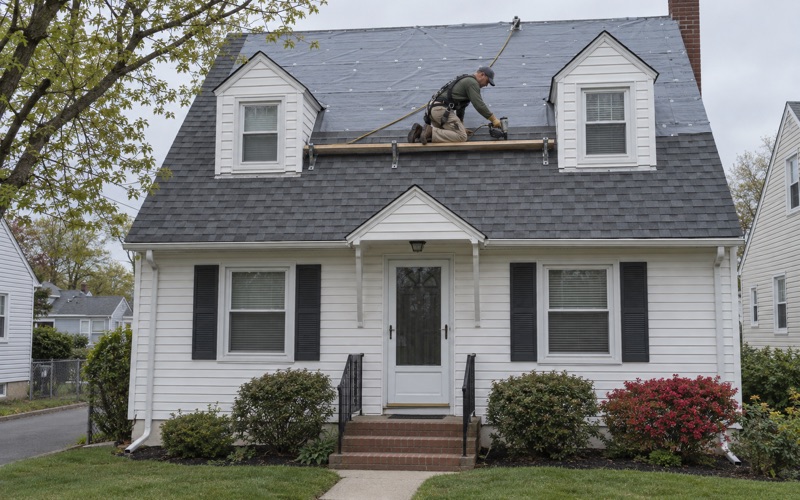
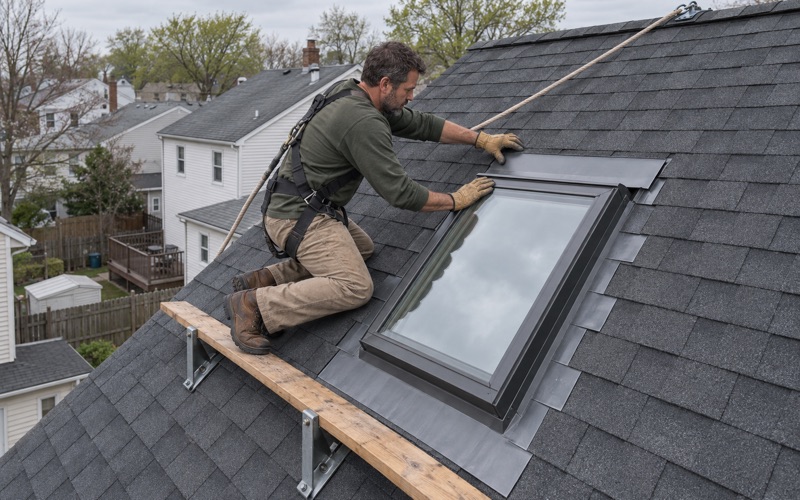
For most houses in Lincoln Park, none of the airspace discussion applies. A ladder and a hoist reach only slightly above the roofline, and a re-roof done that way raises no notice question at all. Our crews work under OSHA’s fall protection rule for residential roofing, which applies at 6 feet. What matters on those jobs is the roof itself.
Replacing a Detached Home’s Roof
Replacing the roof covering on a detached one- or two-family house counts as ordinary maintenance under N.J.A.C. 5:23-2.7 in New Jersey. The state’s rehabilitation subcode, N.J.A.C. 5:23-6, separately requires a tear-off when the roof already carries two or more layers, or where the existing covering is slate, wood shake or tile. We check the layer count before quoting, because it changes the tear-off line.
The borough’s Building Department enforces the Uniform Construction Code, and its FAQ says Lincoln Park requires contractors to be registered with the State of New Jersey as home improvement contractors for building work. New Jersey’s Contractors’ Business Registration Act sets that framework statewide. Our contracts follow the state’s home improvement rules, including the three-business-day cancellation notice on contracts over $500.
Decking, Flashing and Daily Cleanup
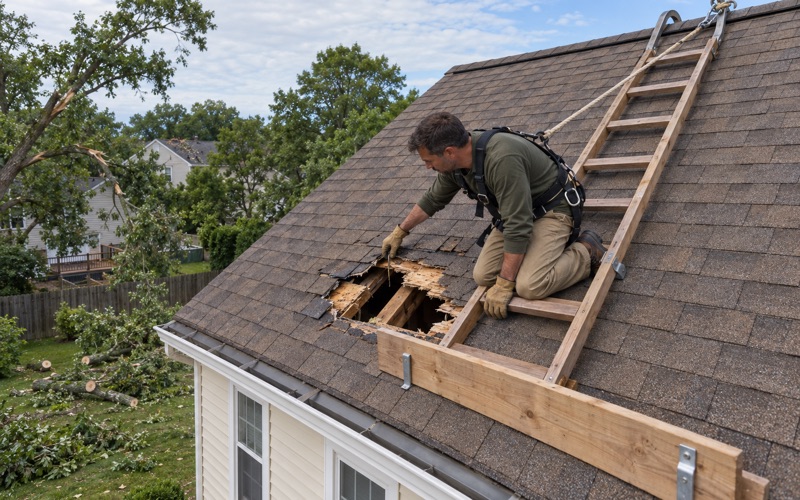
Once the old roofing is off, any damaged decking is photographed and shown to you before it is replaced. The per-sheet price is already in the contract, so a soft spot never becomes an open-ended charge. Then the underlayment goes down, with an ASTM D1970 self-adhering ice and water barrier at the eaves and valleys.
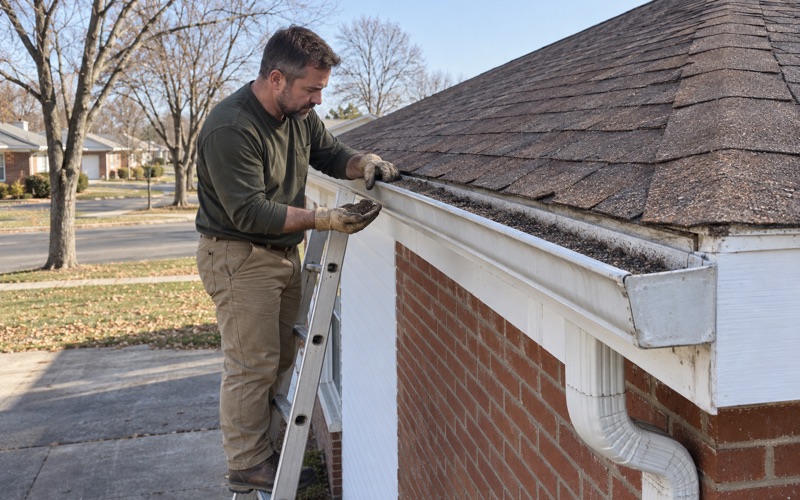
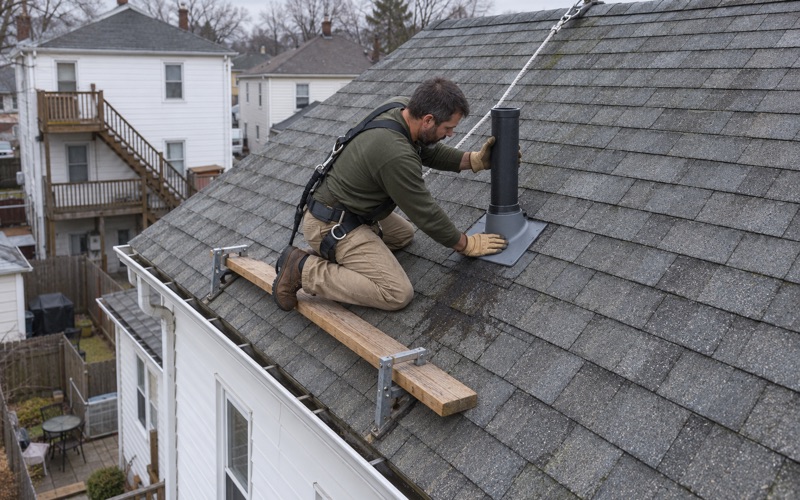
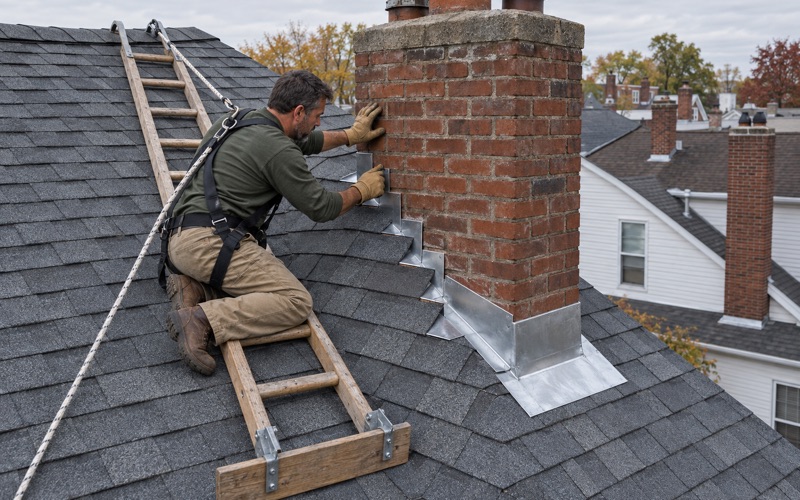
Step flashing, counter flashing and chimney flashing are replaced along with the roof, never reused under new shingles. Drip edge goes on at eaves and rakes, and pipe boots are swapped rather than caulked over. At the end of each day the crew cleans the yard, gutters and driveway, finishing with a magnet sweep for nails.
Storm Leaks and Rental Houses
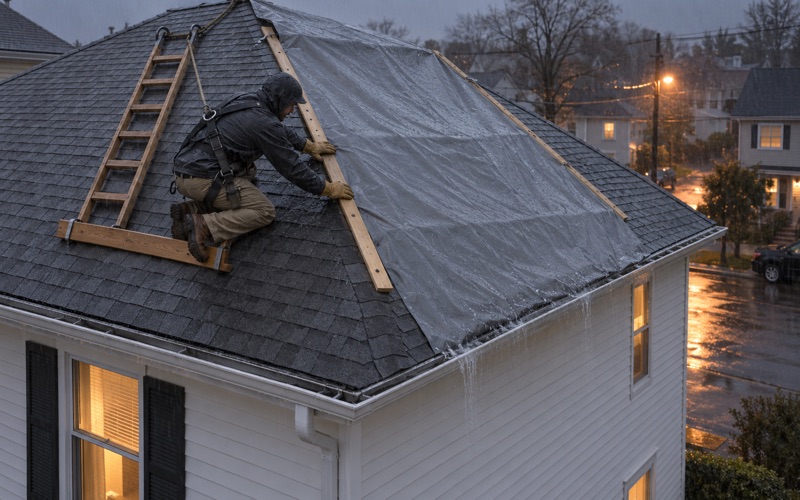
When a storm opens a leak, we photograph the damage and write it up for your own insurance claim, and the crew will meet the adjuster on site if you ask. Lincoln Park sits in National Weather Service forecast zone NJZ008, Morris, issued by the Mount Holly office. That zone’s forecasts are what we watch when scheduling a tear-off.
Rental houses are scheduled with the tenants in mind. The people living there know when the crew is coming and where access is needed, including the attic if a leak is being traced. That notice keeps a one-day repair from turning into a second visit. Owners who live elsewhere get the same schedule by phone or email.
The Borough’s Airport Safety Area Overlay
What the Overlay Says
Separately from the federal notice rule, Lincoln Park’s zoning code establishes an Airport Safety Area as an overlay on the Zoning Map, citing the state Air Safety and Zoning Act and its regulations. The section was amended by Ordinance No. 13-25 on December 1, 2025. It is a local land-use tool, distinct from the FAA’s notice surface.
Among other provisions, the overlay lists as prohibited uses residential dwelling units not on a lot of at least three acres, multifamily dwellings and planned unit developments. We have not read its full text, its boundaries or how it treats existing homes. For that reason we do not tell any owner what the overlay means for their particular lot.
Where to Take Questions
Questions about the overlay go to the borough. The zoning code is administered by the Construction Official and Zoning Officer, and the Building Department answers at 973-270-2028 between 8:00 a.m. and 4:00 p.m. A replacement roof on an existing house is a different matter from new development, but the borough is the authority on its own map.
Our part is narrower and practical. We tell you when a planned lift deserves an airspace check, we keep the delivery method in the written scope, and we never let equipment height become a surprise on installation day. For most roofs in the borough, that answer is simply a ladder, a hoist and a clean yard by evening.
- 20+ Years in Roofing
- Itemized Written Estimates
- Attic-to-Roof Leak Tracing