
Perth Amboy Elite Roofing has handled roof repair in Perth Amboy, NJ for 20+ years, serving surrounding cities including South Amboy, Metuchen, South River, Highland Park and Roselle Park. We fix shingle roofs, flat rear roofs, flashing, slate and the small penetrations where most leaks begin, on houses, two-family rentals and small commercial buildings.
A repair only works if it fixes the place water actually gets in. Before pricing, we look from the attic or top-floor ceiling as well as from the roof, because a stain on the plaster is rarely directly below the opening that caused it. You then get a plain answer on whether the roof can be repaired, before anyone brings up replacement.
The sections below cover the repairs we make most often, how they differ on pitched and low-slope roofs, the conditions particular to older houses here, and how we decide when a repair is the right call.
Shingle Roof Repairs on Pitched Roofs
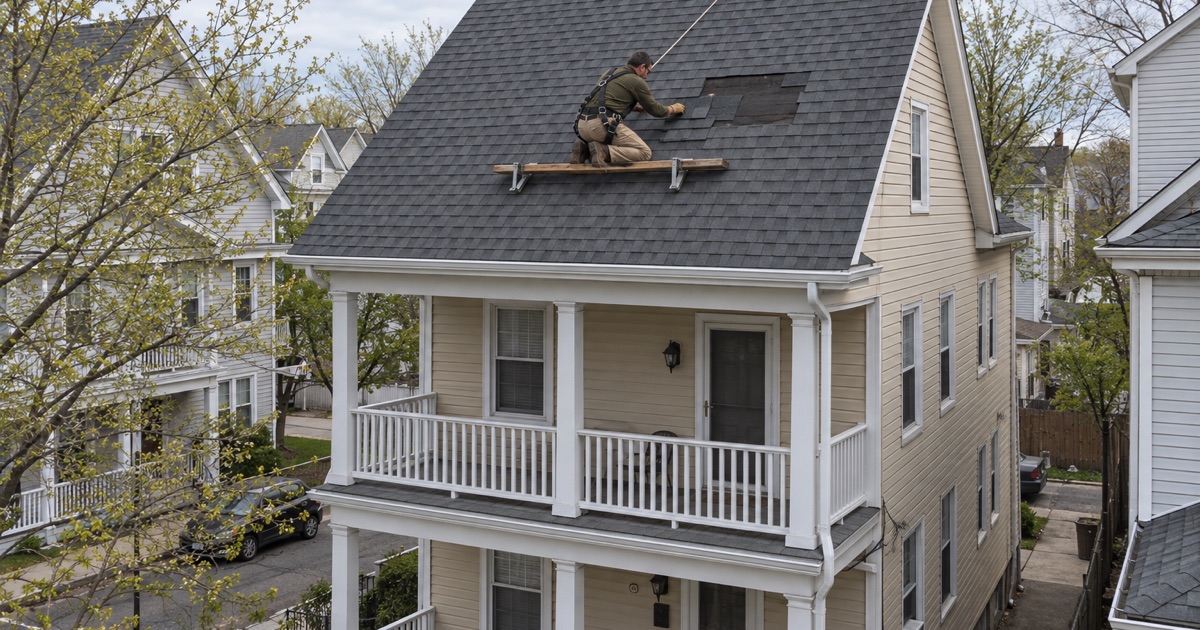
Replacing Damaged or Missing Shingles
Shingles fail one at a time before they fail all at once. Wind lifts an edge, the seal strip lets go, and the next storm creases or tears the tab until water can run beneath it. We remove the damaged pieces, slide new shingles under the course above, and nail and seal them so they lie with the rest of the slope.
We also check the shingles around the repair. If neighboring tabs are loose or the seal strips have dried out, fixing only the missing piece leaves the next failure waiting a few feet away.
Flashing Repairs at Walls, Chimneys and Valleys
Most leaks on a sound roof come from flashing rather than shingles. Step flashing along a sidewall, counter flashing set into a reglet or mortar joint, apron flashing at the bottom of a wall and kick-out flashing at the eave all have to shed water in the right direction. When one piece rusts through or pulls loose, we replace the section rather than smearing sealant over it.
Valleys get the same attention, since two slopes empty into them. Worn or cracked valley metal, or shingles cut too short at a closed valley, send water straight under the roof.
Pipe Boots, Vents and Small Penetrations
The rubber collar around a plumbing vent cracks in sunlight long before the shingles around it wear out, and it is one of the most common leak sources we find. We replace cracked boots with new rubber boots or lead flashing boots, reseal exhaust vents and reset loose roof vents. Each one is a small repair that keeps a ceiling stain from growing.
Chimney Flashing and Crown Repairs
A brick chimney leaks in two ways: through failed flashing where it meets the roof, and through a cracked crown or open mortar joints that let water soak down the masonry. We replace step and counter flashing as a set, add a cricket behind wide chimneys so water cannot pool against the brick, and repoint or recap where the masonry needs it. Fixing only one of the two leaves the other to keep the ceiling wet.
Drip Edge and Gutter-Line Repairs
The lowest course of a roof does the most work, because every drop from the slope above passes over it. Missing or bent drip edge lets water curl back under the shingles and into the fascia, and a gutter hung too low catches less of it. We replace damaged drip edge at the eaves and rakes, check that the shingles overhang into the gutter, and repair the fascia where it has started to soften.
Flat Roof and Commercial Roof Repairs
Seams and Blisters on Modified Bitumen
Torch-down SBS and APP modified bitumen is common on rear additions and small commercial roofs here. Seams open where the laps were not fully bonded, and blisters form where moisture was trapped during installation. We cut out blisters, dry the area, and torch new cap sheet over failed seams with generous laps.
Before patching, we check whether the insulation below is wet. Patching over soaked insulation only hides the problem until the next freeze.
EPDM and TPO Membrane Repairs
EPDM rubber and TPO single-ply membranes fail differently. EPDM tends to pull apart at seams and around penetrations as its adhesive ages, while TPO is more often punctured or split at a heat-welded seam. We clean and prime the membrane, then apply a matching patch with the correct seam tape or a hot-air weld, so the repair bonds to the original sheet.
Parapets, Coping and Edge Metal on Small Buildings
On storefronts and small apartment buildings, the parapet walls take as much weather as the roof itself. Cracked coping, open through-wall flashing and loose edge metal let water into the wall, where it shows up as interior damage far from the roof. We reset or replace coping, reflash the base of the parapet and secure edge metal so wind cannot peel it back.
Scuppers and roof drains are part of the same repair. A clogged outlet backs water over the membrane and turns a small seam problem into a large leak.
Repairs Older Perth Amboy Houses Need
Soft Spots in Board Decking
Many older houses in the city have plank board decking instead of plywood, and the boards can rot where a leak went unnoticed for years. When we open a section and find soft wood, we photograph it, show it to you, and replace it before new shingles go on. Shingles nailed into rotten wood will not hold, however good the shingle.
Slate Repairs With Copper Nails and Slate Hooks
A slate roof can outlast several asphalt roofs, but individual slates crack or slip when their nails corrode. We remove the broken slate and slide in a replacement held with a copper slate hook or copper nails. Walking on slate breaks more of it, so the work is done from ladders and hook supports to protect the slates around the repair.
Painted Trim, Fascia and Lead-Safe Work
Homes built before 1978 may have lead paint on the trim and fascia that a roof repair disturbs. The EPA Renovation, Repair and Painting rule sets lead-safe practices for that work, including containment and cleanup. We plan repairs that touch painted trim on older houses with those requirements in mind.
Deciding When a Repair Is the Right Call
Signs a Repair Will Hold
A repair makes sense when the damage is limited to one area and the rest of the roof is in good shape. Shingles that still lie flat, granules that have not washed into the gutters, and a deck that feels firm underfoot all point toward a repair that will last for years.
Age alone does not decide it. A fifteen-year-old roof with one bad vent boot is a repair, while a younger roof installed over rotten decking may not be worth patching at all.
When We Recommend Replacement Instead
If shingles are curling across several slopes, leaks keep returning in new places, or the deck is soft in more than one spot, repeated repairs cost more than they save. New Jersey also requires a tear-off once a roof already has two layers, so a worn second layer cannot simply be covered again. In those cases we explain why replacement is the better value, in writing.
What a Repair Estimate Shows
Our repair estimates name the area being repaired, the materials, any flashing being replaced and whether decking may need attention once the roof is opened. That way you can see what the price covers, and nothing is added without your agreement.
- 20+ Years in Roofing
- Itemized Written Estimates
- Attic-to-Roof Leak Tracing